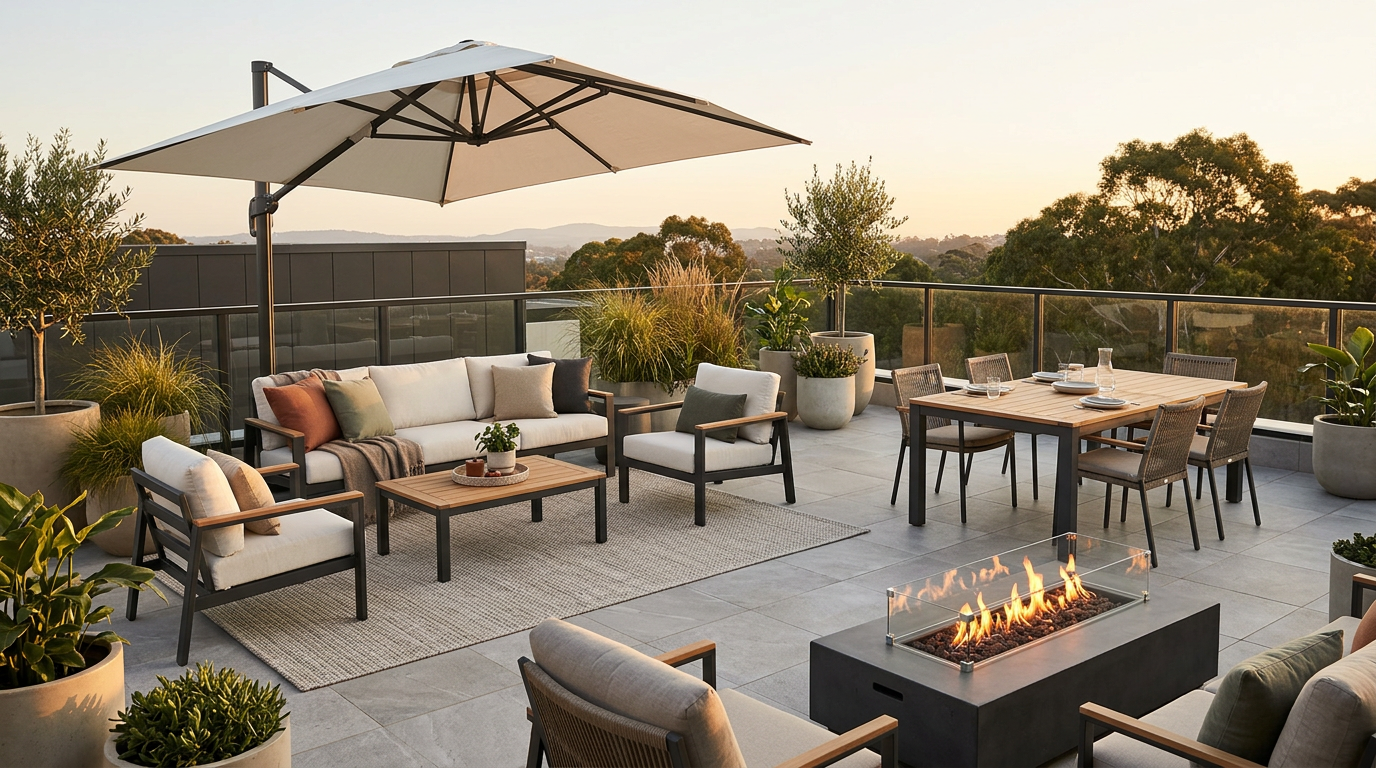
Buying wholesale outdoor furniture means assembling four things at once: seating, dining, warmth and light, and the soft goods that hold the space together. A complete range covers all four, because outdoor buyers rarely take a sofa without also needing a rug, a table, and something that keeps the area usable after sunset. The harder part is timing. Outdoor is bought roughly six months before it sells, which makes it the category where a sourcing mistake sits on your balance sheet the longest.
That gap is why experienced outdoor buyers plan differently from the rest of the year. A retailer who commits to a container of dining sets in January is not paid back until the first warm weekend in May. Anything still in the warehouse by Labor Day gets marked down, and the markdown comes out of the same margin that justified the order.
This guide covers what a complete range contains, when the trade actually buys it, how the money moves while you wait, what to specify so the product survives a season outdoors, and what the federal flammability standard does and does not require of outdoor seating.
What goes into a complete outdoor range?
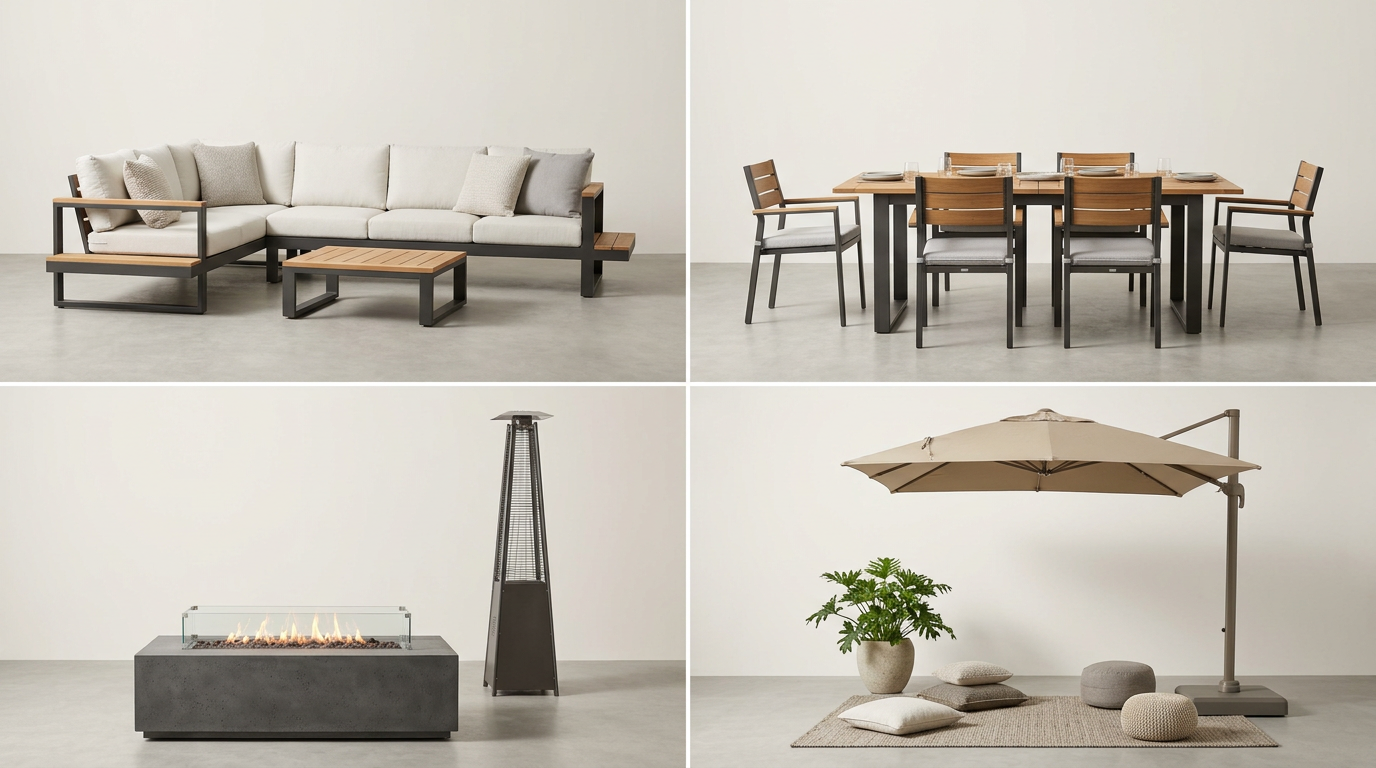
A complete outdoor range covers four zones: seating and lounge, dining and serving, warmth and light, and shade and soft goods. Stocking only seating leaves margin behind, because accessories attach to the same sale, carry lighter freight, and turn faster than the large pieces they sit alongside.
The four zones are worth treating as separate buying decisions, because they behave differently on lead time, freight, and reorder rate.
- Seating and lounge. The anchor purchase and the slowest mover. Outdoor chairs, sofas, sectionals, conversation sets, benches, and swings.
- Dining and serving. Where hospitality and licensed-business buyers concentrate. Outdoor dining sets, tables, bar chairs, and the barware, dinnerware, and serving pieces that go on top of them.
- Warmth and light. The zone that extends the usable season at both ends of the year. Fireplaces and firepits, heaters, fire pit accessories, and hanging lights.
- Shade and soft goods. The highest reorder rate in the category and the lightest to ship. Umbrellas, outdoor rugs, pillows, throws, planters, and privacy screens.
Buyers who cover all four zones can sell a finished space rather than a piece of furniture, which raises average order value without adding a second supplier relationship.
When do trade buyers actually buy outdoor furniture?
The North American outdoor trade buys in September. Casual Market Chicago, the market dedicated to outdoor and casual furnishings and endorsed by the International Casual Furnishings Association, runs at theMART each September for the following season. The assortment a shopper sees in May was largely committed eight months earlier.
That calendar exists because the selling season is short and the manufacturing lead time is not. Traditional outdoor sourcing runs on a fixed annual loop: see the lines in September, place orders through autumn, take delivery over winter, sell from March to August, clear what is left in September. Miss the ordering window and you are buying from whatever inventory other people declined.
The seasonal shape is visible in official data. The Census Bureau applies seasonal adjustment factors to furniture and home furnishings retail sales precisely because the raw monthly figures swing on a predictable annual cycle, and the gap between the adjusted and unadjusted series for any given month is a direct measure of how far that month sits from the annual average. Outdoor is one of the categories driving that swing. (U.S. Census Bureau, Monthly Retail Trade)
What changes for a self-serve buyer. The September calendar is built around overseas manufacturing lead times. Buying from a domestic warehouse decouples you from it, because the stock already cleared customs and is sitting in the country. That turns a once-a-year commitment into a decision you can make monthly, which is the single biggest structural advantage available to a small outdoor buyer.
Why outdoor has the longest cash-out days of any category
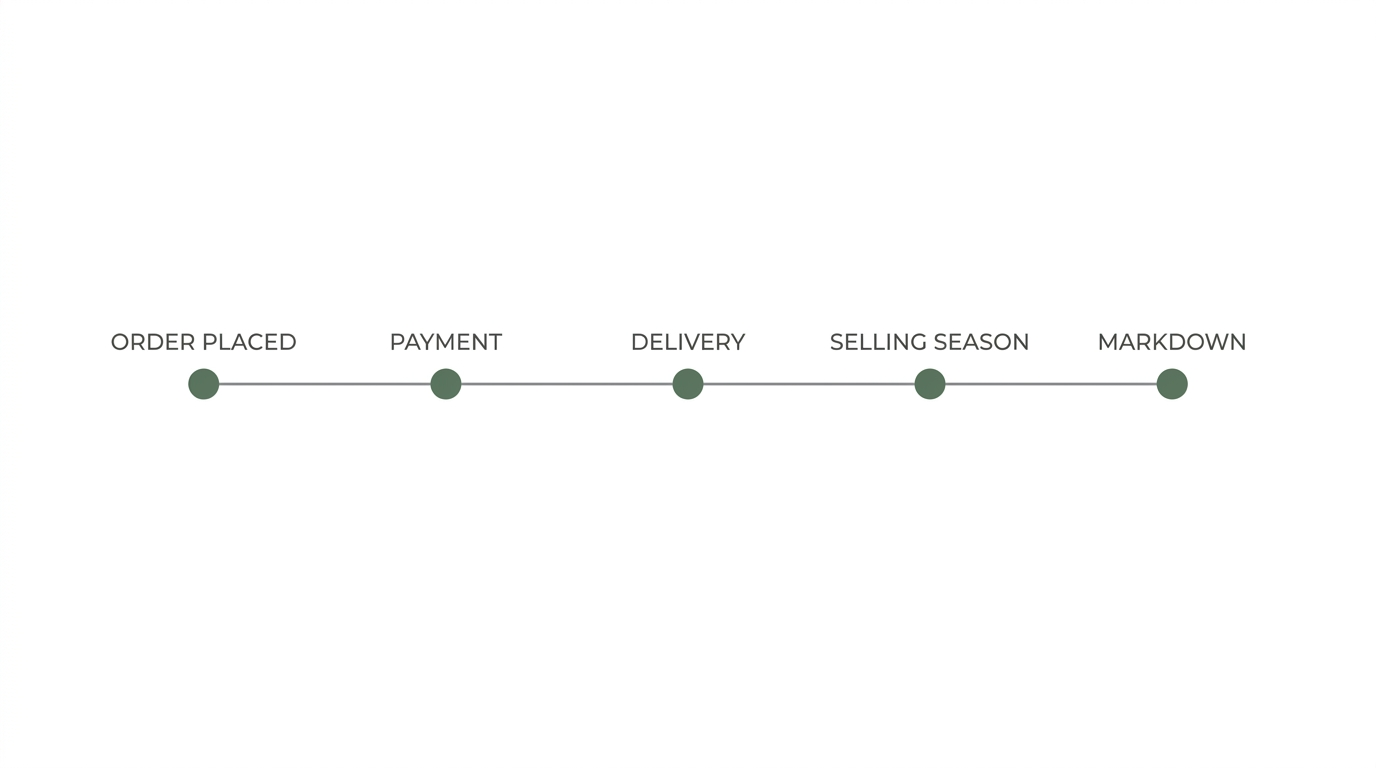
Cash-out days measure the gap between paying your supplier and being paid by your customer. Outdoor runs the longest gap of any home category, because the buying calendar and the selling season sit roughly six months apart. Container buying widens the gap. Dropshipping closes it almost entirely.
The number matters more than the unit price, and outdoor is where that becomes obvious. A dining set bought 15 percent cheaper by the container is not cheaper if the money is locked up for seven months and half the order is still unsold in September. Work out the cash-out days before you compare cost per unit.
| Buying method | Cash-out days | Unit cost | Best fit for outdoor |
|---|---|---|---|
| Container direct | 180 to 240 | Lowest | Established retailers with warehouse space, a proven sell-through history on the exact SKUs, and the working capital to carry a season |
| Domestic wholesale stock | 30 to 90 | Middle | Retailers and hospitality buyers who need product this season, want to test a range before committing, or cannot forecast eight months out |
| Dropship | Close to zero | Highest | Online sellers and designers who never want to hold seasonal inventory, and anyone testing which outdoor categories actually sell before buying stock |
Most outdoor buyers end up running two of these at once: stock on the items they know turn, dropship on the long tail and the oversized pieces where freight and storage do the most damage. Net terms financing changes the arithmetic again, because it moves the payment date without moving the delivery date.
How do you specify outdoor furniture that lasts more than one season?
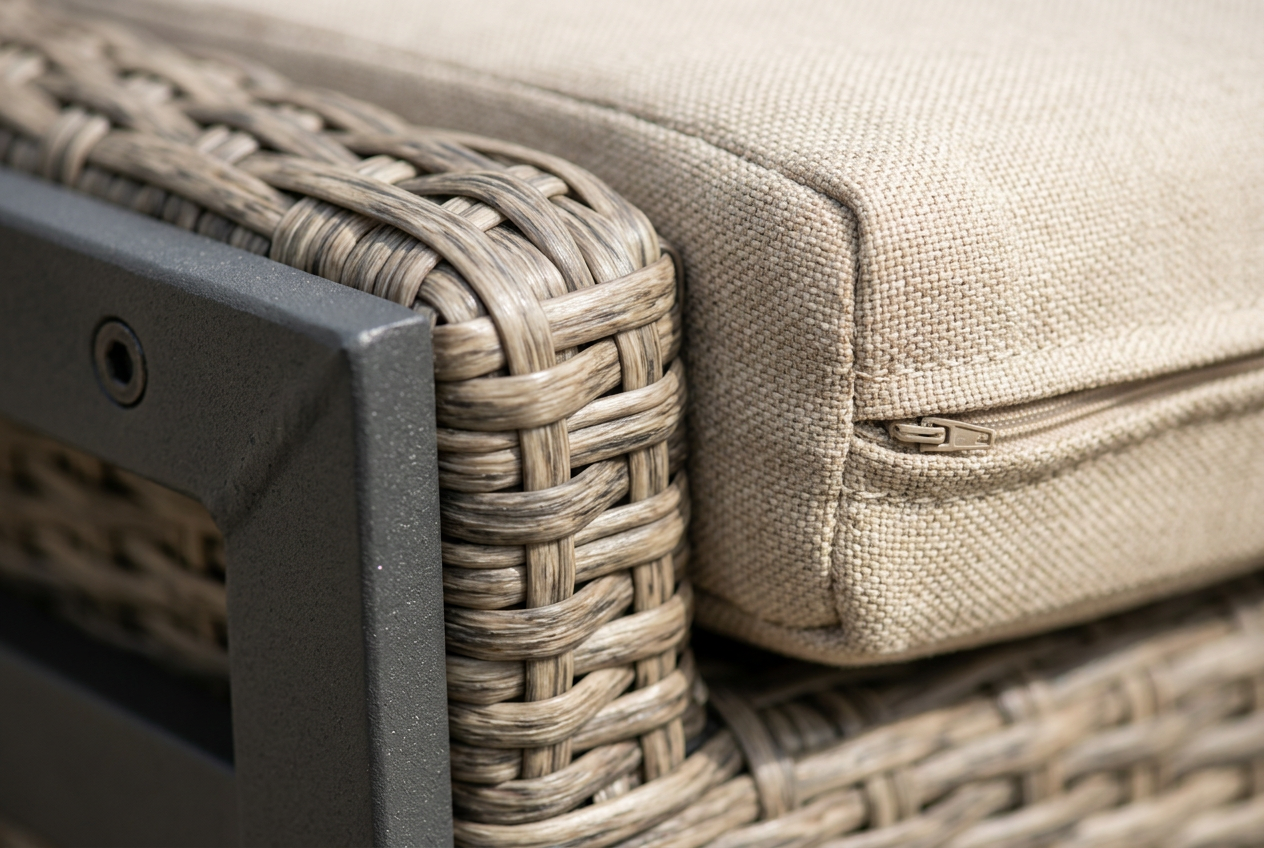
Specify outdoor furniture by frame, weave, and cushion separately, because the three components fail at different rates. The frame usually outlives everything attached to it. Cushions are normally the first thing to go. Checking the cushion and cover specification tells you more about a five-year outcome than the frame material does.
Frames
Powder-coated aluminium is light, does not rust, and is the most common commercial frame. Teak and other dense hardwoods weather to a grey patina unless oiled, which is a maintenance decision rather than a defect. Steel is heavier and stronger at the joint but depends entirely on the coating, so a chipped powder coat on a steel frame is a genuine problem in a way it is not on aluminium.
Weaves
Resin wicker over an aluminium core behaves differently from the same weave over steel, and product listings do not always make the core material obvious. Where the specification is available, check it. Where it is not, ask before committing to volume.
Cushions and covers
Ask for the fill, the cover fabric, and whether covers are removable. Removable covers turn a replacement into a repair, which matters most to hospitality and rental buyers replacing a handful of units rather than a whole terrace. Fibre content on any textile component is a labelled requirement under the Textile Fiber Products Identification Act, so it should be available on request for every item you buy.
A practical filter. Many catalogues, including this one, carry a commercial-use flag on outdoor items. For hospitality, licensed-business, and high-traffic retail buyers, filtering on that flag first is faster than reading specifications one product at a time, and it removes the pieces built for a domestic patio from a list intended for a pool deck.
Does outdoor furniture need to meet the federal flammability standard?
In most cases, no. The federal upholstered furniture flammability standard at 16 CFR part 1640 defines upholstered furniture as seating intended for indoor use, and separately exempts cushions and pads intended solely for outdoor use. Furniture marketed as suitable for both indoor and outdoor use is where that exemption stops being straightforward.
This is worth knowing because it is widely misunderstood. The standard adopted California Technical Bulletin 117-2013 as a federal requirement and applies to upholstered furniture manufactured, imported, or reupholstered on or after 25 June 2021, with a certification label required from 25 June 2022. The Consumer Product Safety Commission definition of upholstered furniture is explicitly limited to articles intended for indoor use, and the exemption list at section 1640.5(b) names cushions and pads intended solely for outdoor use. (CPSC, Upholstered Furniture)
The dual-use listing is the thing to check. A large share of outdoor seating is marketed as suitable for indoor or outdoor use, which is a selling point for the buyer and a question for compliance, because the exemption is written around cushions intended solely for outdoor use. If you are reselling into a market with its own labelling rules, or supplying a commercial setting, confirm the labelling position with your supplier before the order rather than after. Nothing here is legal advice, and the wording of the standard itself is at 16 CFR part 1640.
Separately, California Proposition 65 warning obligations can apply to outdoor products regardless of the flammability position, and they attach to the seller as well as the manufacturer. If you ship into California, that is a supplier conversation worth having once, at the start of the relationship.
What should each type of buyer prioritise?
Outdoor serves five distinct trade buyers who want different things from the same catalogue. Designers need lead-time certainty. Online sellers need freight-friendly items. Physical retail needs floor-ready sets. Hospitality needs matching units it can replace one at a time. Businesses buying for their own premises need durability ahead of range.
| Buyer | What to prioritise |
|---|---|
| Interior designers and stagers | Lead time you can promise a client, and pieces available now rather than on a seasonal drop. Dropship removes the storage problem entirely on a terrace install. Shade and soft goods finish a photograph, so buy those alongside the seating, not after it |
| Online stores | Freight cost against unit value. Rugs, pillows, planters, and serving pieces carry better margin after shipping than a sectional does. Test the category with dropship before holding outdoor stock through a winter |
| Physical retail | Complete sets that display as a finished space, plus the accessories to dress them. Floor-ready matters more outdoors than indoors, because customers are buying an idea of a garden rather than a single item |
| Hospitality | Matching units you can reorder in small quantities for years, and a commercial-use rating. Replaceable cushion covers reduce the cost of a refresh substantially. Confirm reorder availability before standardising a property on a range |
| Licensed businesses buying for their own use | Durability and maintenance load ahead of style breadth. Powder-coated aluminium and removable covers reduce the annual cost of ownership more than a lower purchase price does |
How do you build a first outdoor range?
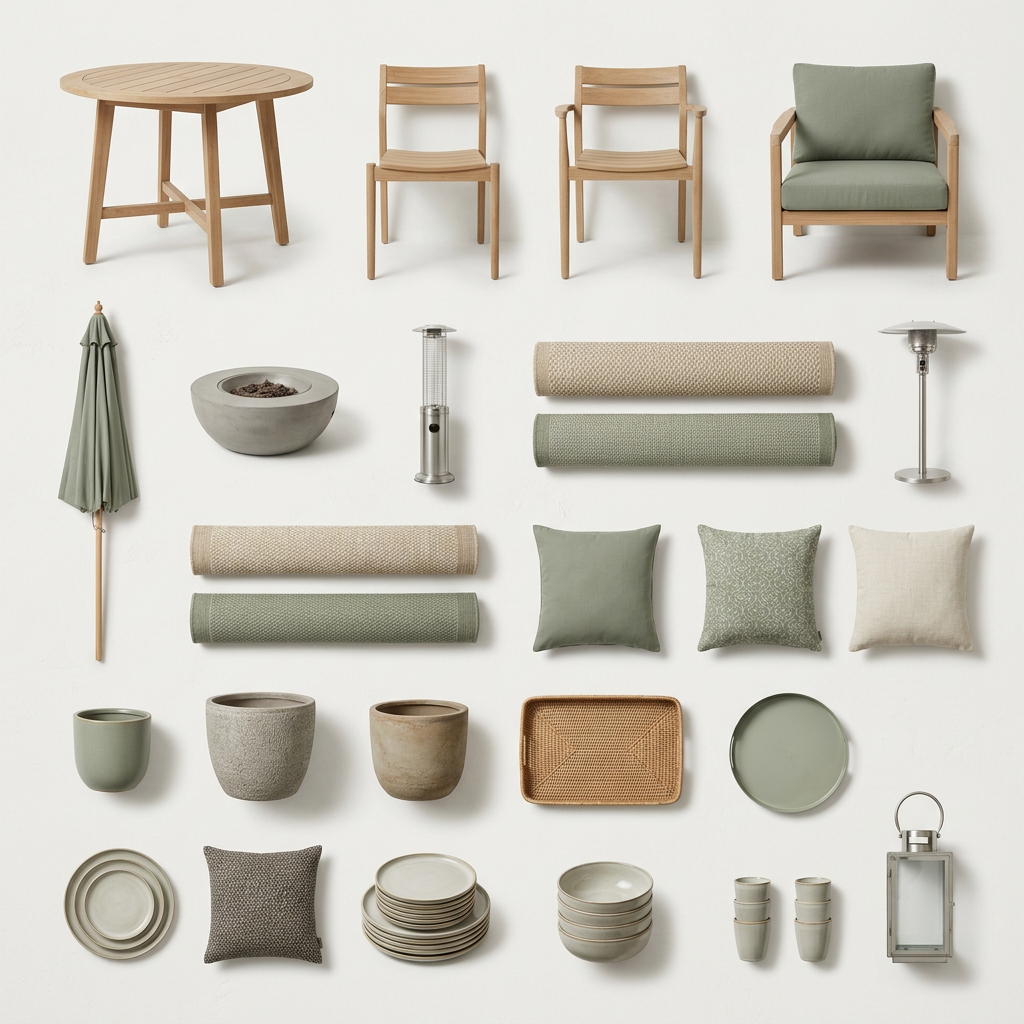
A workable first outdoor range runs to roughly twenty items across the four zones, weighted toward accessories. One dining set, two seating configurations, one fire feature, shade, and then the rugs, pillows, planters, and serving pieces that fill the space between them. Accessories carry the reorder rate.
| Zone | Share | What to include first |
|---|---|---|
| Seating and lounge | 4 to 6 items | One conversation set, one dining-adjacent chair, one bench or swing. This is the display anchor and the slowest turn |
| Dining and serving | 4 to 5 items | One complete dining set, one bar-height option, then dinnerware and serving pieces at a much lower unit cost |
| Warmth and light | 3 to 4 items | One firepit or fire table, one heater, hanging lights. This zone sells hardest in early spring and again in autumn |
| Shade and soft goods | 6 to 8 items | Umbrella and base, two outdoor rug sizes, pillows in two palettes, planters. Lightest freight and fastest reorder in the range |
Start narrow on the large pieces and wide on the accessories. The large items tell you whether your customers buy outdoor at all. The accessories are what they come back for, and they are cheap enough to be wrong about.
The full assortment across all four zones is in the outdoor category. Wholesale pricing is visible once a trade account is approved.
Frequently asked questions
What is the minimum order for wholesale outdoor furniture?
It depends entirely on the supplier model. Manufacturers selling by the container typically set minimums by unit count or full container load. Domestic wholesale marketplaces often set no minimum at all, which is what makes them usable for a first outdoor range or for testing a category before committing to a season of stock.
When is the best time to buy outdoor furniture wholesale?
For traditional sourcing, September through November, aligned to the trade market calendar and the manufacturing lead times behind it. For domestic warehouse stock the timing is far more flexible, because the inventory is already in the country. Late-season buying from domestic stock is a genuine strategy for anyone with storage.
Is outdoor furniture exempt from the federal flammability standard?
Cushions and pads intended solely for outdoor use are exempt under 16 CFR section 1640.5(b), and the standard defines upholstered furniture as seating intended for indoor use. Items marketed for both indoor and outdoor use sit in a less clear position, so confirm the labelling with your supplier.
Do I need a licence to buy outdoor furniture wholesale?
Most wholesale suppliers require proof that you are a business, usually a resale certificate or a state sales tax permit, which lets you buy without paying sales tax on goods you intend to resell. Requirements are set at state level. Businesses buying for their own premises rather than for resale are in a different position again.
How much outdoor stock should a first-time buyer hold?
Less than feels right on the large pieces, and more than feels right on the accessories. Seating and dining sets carry the freight cost, the storage cost, and the markdown risk. Rugs, pillows, and planters reorder faster, cost less to be wrong about, and attach to almost every outdoor sale.
What is the difference between residential and commercial outdoor furniture?
Commercial-rated outdoor furniture is specified for higher use frequency and, in many cases, higher weight capacity and stronger joints. Hospitality, restaurant, and multi-unit buyers should filter for a commercial-use rating rather than reading individual specifications, because the rating exists to answer exactly that question.
Sourcing outdoor for the season ahead
Outdoor rewards buyers who plan around the calendar and punishes buyers who react to the weather. The four zones tell you what a complete range contains. The cash-out days tell you which buying method your business can actually carry. The specification work tells you what will still be sellable in year three.
If you are building an outdoor range now, start with the accessories while you decide on the anchor pieces. They ship cheaply, they turn quickly, and they teach you what your customers want before you commit a season of working capital to finding out.
Create a free trade account to see wholesale pricing across the outdoor range, or browse the full outdoor category first.