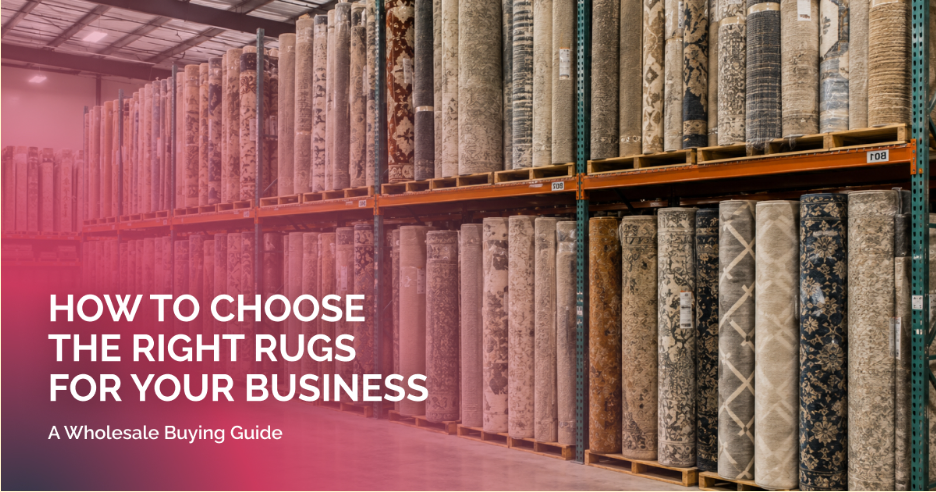
How to Buy Rugs Wholesale: A Sourcing and Stocking Guide for Retailers, Designers, and Dropshippers
Last updated: Aug 12, 2026. Written by the HomeRoots trade team.
Somewhere in most rug retailers’ stockrooms there is a 9x12 that has been sitting for eleven months. It looked incredible in the catalog. It cost more to freight in than three 5x8s. And it is still there, holding capital that should have turned over twice by now.
That rug is the whole problem with buying rugs wholesale. The decisions that sink margins are not aesthetic ones. They are fiber, size mix, freight, and returns, in roughly that order. This guide covers how to plan a wholesale area rug buy so the stock you commit to actually sells through, whether you run a storefront, a design practice, or a dropship catalog.
The short version
Before you place an order, you should be able to answer these:
- Fiber matches use. Polypropylene for outdoor and high-traffic. Wool where the customer pays for longevity. Viscose only in low-traffic accents.
- Sizes are weighted, not even. 5x8 and 8x10 carry the volume. 9x12 and larger are special-order candidates, not opening-stock candidates.
- Freight is priced per unit, not per order. A rolled 9x12 can cost more to move than the margin it carries.
- Fiber content is labeled correctly. Mis-described rugs come back, and the labeling obligation follows you, not just your supplier.
- The stocking model is a decision. Stock, dropship, or both, chosen deliberately rather than by default.
- Terms are agreed before the order, not during it.
|
|
Which rug fibers actually hold up for your customers?

Match fiber to how the room gets used, not to how the rug photographs. Polypropylene handles moisture, sun, and heavy foot traffic at the lowest cost per unit. Wool justifies a premium price and lasts. Viscose looks like silk and fails fast in traffic. Fiber choice is the single largest driver of your return rate.
Most returns in this category are not damage claims. They are expectation failures. A customer buys a rug with a silky sheen for a hallway, it browns and crushes within a season, and it comes back. That return costs you the freight both ways, the restocking labor, and usually the customer.
|
|
|
|
|
|
|
|
|
|
|
|
|
|
|
|
|
|
|
|
|
|
|
|
|
|
|
|
|
|
|
|
|
|
|
|
|
|
|
|
|
|
Which rug sizes should you stock first?

Weight your opening buy toward 5x8 and 8x10, add runners and 2x3 scatter sizes for accessory attachment, and treat 9x12 and larger as reorder-driven rather than stocked. Standard US sizes run 2x3, 3x5, 4x6, 5x8, 6x9, 8x10, 9x12, and 10x14, plus runners and rounds. The large end ties up disproportionate capital.
This is where most first buys go wrong, and it goes wrong for an understandable reason: the big rugs are the ones that look impressive on a showroom floor and in a listing photo. They are also the slowest to turn and the most expensive to hold.
|
|
|
|
|
|
|
|
|
|
|
|
|
|
|
|
|
|
|
|
|
|
|
|
|
|
|
|
|
|
|
|
|
|
|
|
|
|
|
|
|
|
The sizing reference published by Rugs Direct identifies 8x10 as the most commonly requested living room size, and the pattern holds across most US retail assortments.
One detail that generates more returns than it should: US size labels are approximate. Rug Branch points out that what gets sold as an 8x10 is frequently produced and labeled as 8x11, and an "8x10" from one mill may actually measure 7’10" by 10’2". Publish the true measured dimensions on your listings rather than the marketing size. A customer who measured their room to the inch and received a rug two inches short will file a return, and they will be right to.
Apply the reorder test here more strictly than anywhere else. A 9x12 that sells twice a year is not a stocking decision, it is a photography prop with a carrying cost.
What makes wholesale outdoor rugs different from indoor stock?

Outdoor rugs are specified on four criteria indoor rugs ignore: UV stability, mold and mildew resistance, drainage, and cleanability The genuine advantage for a buyer is that most modern outdoor stock is indoor/outdoor rated, so one SKU sells into two categories and two seasons.
The dual-category point is the one most buyers miss. An indoor/outdoor rug can merchandise in your outdoor category from March through August and move to entryways, kitchens, mudrooms, and pet-household listings for the rest of the year. That reshapes the seasonality math on the buy. You are not committing capital to a four-month window.
For staging, rental, and short-term-let buyers, indoor/outdoor is often the correct recommendation for the entire property, not just the patio. Cleanability beats hand-feel when the rug has to survive turnover between guests.
HomeRoots stocks indoor/outdoor area rugs and runners across a range of sizes and constructions.

What does a rug really cost to get to your customer?
Landed cost is unit price plus inbound freight plus handling plus your expected return rate. Rugs are unusual among home furnishings because they ship rolled by parcel rather than by pallet, which means dimensional weight, not actual weight, usually sets the price. Cost per unit rises sharply with size.
Parcel carriers bill on whichever is greater, actual weight or dimensional weight, calculated from the package’s length, width, and height. A rolled rug is long and bulky relative to what it weighs, so it almost always prices on dimensions. Once a rug exceeds parcel length limits, it moves to LTL freight and the cost structure changes again.
The practical consequence: the freight cost of a 9x12 is not 2.25 times the freight cost of a 5x8, even though the area is. It is worse, and it lands on a unit that turns more slowly. That is the second reason large sizes belong in a dropship or special-order lane rather than in your opening stock.
Build the number properly before you set retail price. Unit cost, inbound freight allocated per unit, your handling and storage, and a realistic return allowance. Sellers who price off unit cost alone find their margin has already been spent by the time the second reorder lands.
What should you ask a rugs wholesale supplier before your first order?
Ask about stock location, order minimums, lead time, product data quality, return policy on defective goods, and payment terms. Where the inventory physically sits matters most. A US-warehoused supplier ships in days; an overseas manufacturer ships in weeks or months, with customs exposure attached.
Six questions, in priority order:
- Where is the inventory held, and what is the typical time from order to shipment?
- Is there an order minimum, by units or by dollar value?
- What product data comes with the catalog: fiber content, measured dimensions, construction, imagery?
- What is the policy on damaged or mis-described goods, and who pays return freight?
- Do you support dropshipping, and is shipping blind?
- What payment terms are available on a first order?
That last one is worth pushing on. The gap between paying for inventory and selling it is where most first wholesale orders get uncomfortable, particularly if you are buying into a season ahead of demand. Net terms turn a cash-flow problem into a scheduling problem. HomeRoots offers business financing through Credit Key.
Frequently asked questions
What is the minimum order for buying rugs wholesale?
Minimums vary widely. Overseas manufacturers often require container or per-design minimums running into hundreds of units. US-warehoused distributors selling from existing stock typically set much lower thresholds, sometimes by dollar value rather than unit count, which lets smaller retailers and designers buy without committing to a full production run. HomeRoots does not require MOQ (Minimun Order Qty)
Can I buy wholesale rugs without a storefront?
Usually yes. Most wholesale platforms require a business identity rather than a physical store, which typically means a resale certificate or business registration. Interior designers, home stagers, online-only sellers, property managers, and short-term rental operators all commonly qualify without operating retail space.
What is the difference between hand-tufted and hand-knotted rugs?
Hand-knotted rugs are built knot by knot on a loom, with the pile secured by the knot structure itself, and they can last decades. Hand-tufted rugs are punched into a backing cloth and secured with adhesive and a secondary backing. Hand-tufted costs substantially less and wears out sooner.
Which rug sizes sell fastest?
The 5x8 and 8x10 move fastest in most US assortments because they suit the widest range of living rooms and bedrooms. Small accent sizes and runners turn quickly at lower price points and attach well to larger purchases. Sizes above 9x12 sell slowly and hold significant capital per unit.
Are outdoor rugs the same as indoor/outdoor rugs?
Most rugs marketed as outdoor are indoor/outdoor rated, meaning they are built to survive sun and moisture but sell equally well in entryways, kitchens, and pet households. Fully outdoor-only construction is rarer. Indoor/outdoor stock gives a buyer two selling seasons from one SKU.
Do wholesale rug suppliers offer payment terms?
Some do, through in-house credit or third-party B2B financing. Terms let you receive and start selling inventory before payment is due, which matters most when buying into a season ahead of demand. Ask before your first order rather than at checkout, since approval usually takes a short application.
Browse wholesale area rugs and outdoor rugs, or create a wholesale account to see trade pricing across the full catalog.